
Creature Features (26)
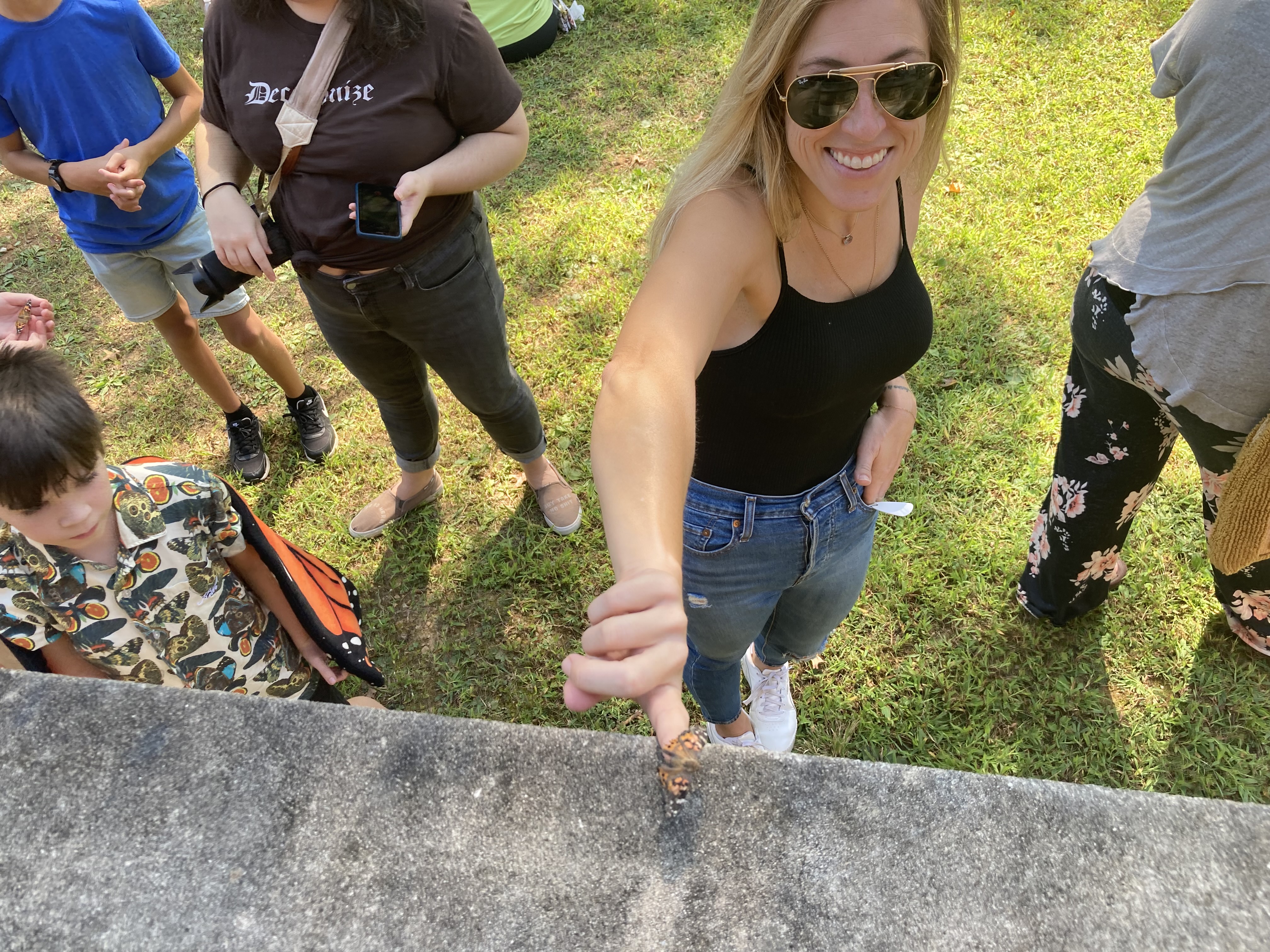 Kat Johnson meets a butterfly during a recent event at the University of Tennessee Arboretum in Oak Ridge. Ben Pounds/Hellbender Press
UT Arboretum event reminds us to love and care for the butterflies among us
OAK RIDGE — With an orange flutter, a cluster of painted lady butterflies took to the sky.
It was a timed release, coming toward the end of the seventh annual University of Tennessee Arboretum’s Butterfly Festival last month.
Earlier, other live painted lady butterflies were available to watch in mesh tents. Visitors got a chance to touch Madagascar hissing cockroaches and look at preserved insect collections with butterflies and other creatures from around the world. Children ran around the event with butterfly face paint, butterfly masks and butterfly wings. But the event was also a chance to buy butterfly-friendly plants and learn about butterflies and their relationships with other species.
- butterfly
- university of tennessee arboretum
- butterfly festival
- pollinator plant
- tennessee naturscapes
- michelle campanis
- stephen lynn bales
- georgeann eubanks
- family garden as butterfly habitat
- jerome grant
- migratory butterfly
- cosmopolitan butterfly
- butterfly garden
- painted lady butterfly
- zebra swallow butterfly
- tennessee state butterfly
- pawpaw
Foreign freshwater jellyfish have been swimming among us since the 1930s
Written by Stephen Lyn Bales
Freshwater jellyfish: Here one year, gone the next.
KNOXVILLE — Paddling along the still water of Mead’s Quarry Lake you notice the air bubbles created by your oars. They are all around your canoe near the surface.
It’s a hot early September afternoon and the nearly transparent bubbles seem to take on a life of their own. You slow to watch and yes, they undulate, rising and falling in the pristine water of the abandoned marble quarry.
Air bubbles do not undulate!
Taking a clear plastic cup, you lean over the gunwale and scoop up one of the penny-sized bubbles to get a closer look.
Tentacles? Air bubbles do not have tentacles. What you are looking at is a freshwater jellyfish and the heat of late summer is its mating season. It’s a blossom of jellyfish as hundreds gather together near the water’s surface. They are commonly known as peach blossom jellyfish.
Citizen scientists are taking stock in Smokies, and the inventory keeps increasing
Written by Thomas Fraser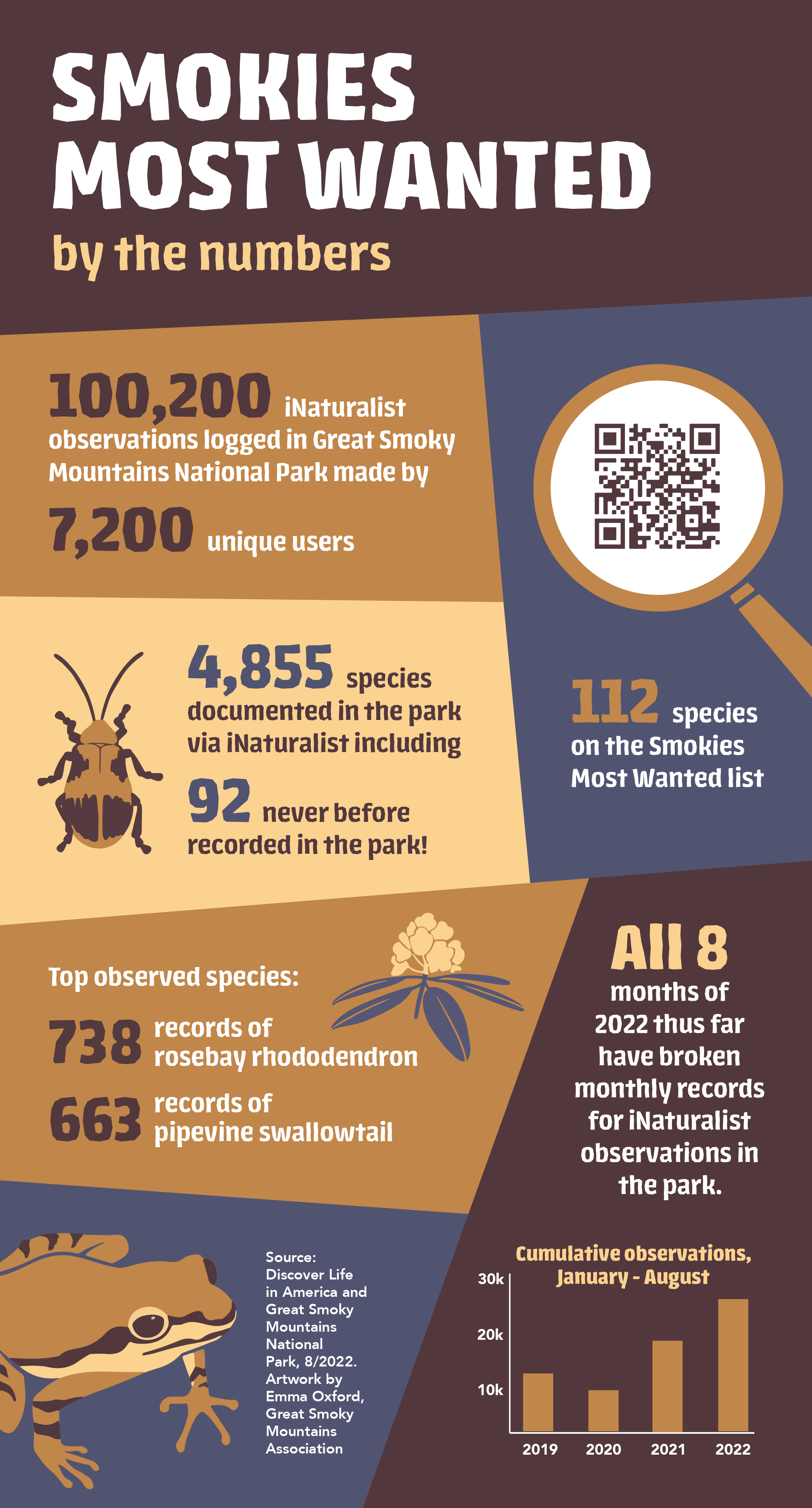
This story was provided by Great Smoky Mountains National Park.
Next demonstration on Thursday, Oct. 20
GATLINBURG — Great Smoky Mountains National Park is celebrating the success of a community science project led by nonprofit partner Discover Life in America (DLiA) called Smokies Most Wanted. The initiative encourages visitors to record life they find in the park through the iNaturalist nature app. DLiA and the park use these data points to map species range, track exotic species, and even discover new kinds of life in the park.
“iNaturalist usage in the Smokies has skyrocketed from just four users in 2011, to 3,800 in 2020, to now more than 7,100 users,” said Will Kuhn, DLIA’s director of science and research.
In August, the project reached a milestone, surpassing 100,000 records of insects, plants, fungi, and other Smokies life submitted through the app. Among them are 92 new species not previously seen in the park.
Smokies researchers make a formal acquaintance with a familiar salamander
 Jonathan Cox
Great news from the Smokies via Instagram!
The “salamander capital of the world” just gained a new member! Meet our 31st species: the Cherokee black-bellied salamander, or Desmognathus gvnigeusgwotli. Its species name means “black belly” in the Cherokee language. Scientists used genetics to find out that it is different from the other black-bellied salamander in the park.
This salamander is common throughout the park and is known for its extremely dark belly and hunting along the banks of streams. If you see a large, dark-bodied salamander with a flattened tail resting on a river rock or poking its head out of a streamside hole, it’s likely the Cherokee black-bellied!
Remember to always appreciate salamanders and other wildlife from afar. Many of our salamanders breathe through their skin. The oils on our hands can stress them out, disrupt their breathing or even spread infections. Please help us keep our salamanders slimy and avoid picking them up!
— Great Smoky Mountains National Park
Monarch butterflies, an ephemeral but regular glimpse of beauty, are fluttering toward extinction
Written by Stephen Lyn Bales  A monarch butterfly, recently declared endangered despite decades of conservation, is seen atop a coneflower. Stephen Lyn Bales
Dramatic monarch declines mean the bell tolls for we
KNOXVILLE — Monarch butterflies are ephemeral by nature. The orange and black dalliances that flitter through our lives, our yards, and our countryside like motes of dust are here one minute and gone the next. We pause for a few seconds to watch the “flutter-bys” and then move on.
For about all of the Lepidopteran family, where they come from, where they go, their raison d'être, we don’t ask. They are winged wisps that pass through our busy lives. But that is not true with this orange and black butterfly, named to honor King William III of England, the Prince of Orange. But two people did ask.
Norah and Fred Urquhart lived in Southern Canada and in the late 1930s they noticed that the monarch butterflies seemed to all be fluttering south this time of the year. Could they possibly be migrating and if so, where did they go? The notion that a butterfly might migrate south for the winter seemed hard to fathom. Yes, broad-winged hawks migrate. But a flimsy butterfly?
- monarch butterfly
- monarch
- are monarchs endangered?
- stephen lyn bales
- stephen bales
- ijams nature center
- lepidoptera
- catalina aguado
- norah and fred urquhart
- flight of the butterflies
- xerces society
- great smoky mountains institute at tremont
- danaus plexippus ssp plexippus
- endangered species
- international union for conservation of nature
- pesticide
- pollinator
- habitat loss
- climate change
- herbicide
- mexico
At Gray Fossil Site, paleontologists let the bone-crushing dog out
Written by East Tennessee State University Illustration of the Gray Fossil Site bone-crushing dog, recently determined to have been active in the ancient Southern Appalachians. Mauricio Anton via ETSU
Discovery of ancient ambush predator is one of few large carnivores found at East Tennessee paleontological site
JOHNSON CITY — Overseen by the Don Sundquist Center of Excellence in Paleontology at East Tennessee State University, researchers have studied the Gray Fossil Site for over 20 years. They have identified many extinct animal and plant species of the Pliocene epoch that lived there some 5 million years ago. While large herbivores are well known from the site, large predators are relatively uncommon, so far including only alligators and scarce remains of at least one sabertooth cat.
Now, there’s a new predator on the scene.
A recent study published in the Journal of Paleontology describes a single right humerus (upper arm bone) of an animal named Borophagus, a member of an extinct group more commonly called bone-crushing dogs. The animal is so named for its powerful teeth and jaws. This is the first evidence of any animals in the dog family from the Gray Fossil Site.
The research was conducted by Emily Bōgner, a doctoral student at the University of California, Berkeley, and alumnus of ETSU’s paleontology master’s program, and Dr. Joshua Samuels, associate professor in the ETSU Department of Geosciences and curator at the Gray Fossil Site and Museum.
An under-appreciated Black scientist pioneered the modern study of bees and other insects
Written by Edward D. Melillo Zoologist Charles Henry Turner was the first scientist to prove certain insects could remember, learn and feel. Charles I. Abramson via The Conversation
Charles Henry Turner concluded that bees can perceive time and develop new feeding habits in response
This story was originally published by The Conversation. Edward D. Melillo is a professor of history and environmental studies at Amherst College.
On a crisp autumn morning in 1908, an elegantly dressed African American man strode back and forth among the pin oaks, magnolias and silver maples of O’Fallon Park in St. Louis, Missouri. After placing a dozen dishes filled with strawberry jam atop several picnic tables, biologist Charles Henry Turner retreated to a nearby bench, notebook and pencil at the ready.
Following a midmorning break for tea and toast (topped with strawberry jam, of course), Turner returned to his outdoor experiment. At noon and again at dusk, he placed jam-filled dishes on the park tables. As he discovered, honeybees (Apis mellifera) were reliable breakfast, lunch and dinner visitors to the sugary buffet. After a few days, Turner stopped offering jam at midday and sunset, and presented the treats only at dawn. Initially, the bees continued appearing at all three times. Soon, however, they changed their arrival patterns, visiting the picnic tables only in the mornings.
Smokies rangers kill bear after it hurts Elkmont campers while seeking food
Written by Thomas Fraser6-minute video about what to do if you see a black bear
Smokies officials say euthanized bear was overweight and seeking human food
GATLINBURG — Great Smoky Mountains National Park wildlife biologists and park rangers responded to Elkmont Campground on Sunday (June 12) after a peculiarly large black bear injured a toddler and her mother sleeping in a tent.
Wildlife biologists captured the responsible bear, and it was euthanized Monday, June 13, according to a news release from the park service.
“The bear weighed approximately 350 pounds, which is not standard for this time of year, suggesting the bear had previous and likely consistent access to non-natural food sources,” said Lisa McInnis, resource management chief.
Wild animals just aren’t that into you. Give them space or suffer the consequences.
Written by Jennifer Weeks A radio-collared bull elk is seen at rest in Cataloochee Valley. Great Smoky Mountains National Park
Please don’t feed or get attacked by the animals
This story was originally published by The Conversation.
Millions of Americans enjoy observing and photographing wildlife near their homes or on trips. But when people get too close to wild animals, they risk serious injury or even death. It happens regularly, despite the threat of jail time and thousands of dollars in fines.
These four articles from The Conversation’s archive offer insights into how wild animals view humans and how our presence affects nearby animals and birds — plus a scientist’s perspective on what’s wrong with wildlife selfies.
 A male carpenter bee takes a break from building its nest to get nourishing nectar from the base of a penstemon. Juian Cowles/U.S. Forest Service
Please don’t wage chemical warfare on these busy bees
KNOXVILLE — Old George Harvey lived two houses upstream from where I grew up on Baskins Creek in Gatlinburg. He had a strange obsession. Using empty jars, Old George would catch bees he found on the flowers and gardens around his house, screw on the lid and line the jars up on a ledge inside his screened-in porch. He’d then watch the bees die.
We kids thought it was odd and cruel. We’d plot slipping into his porch and freeing all the bees like Elliot freed the frogs from the classroom in the movie “E.T. The Extra-Terrestrial.”
More...
 Tennessee Aquarium Director of Hospitality and Marketing Meredith Roberts and her daughter Lucy release a juvenile lake sturgeon during an Earth Day event on the Chattanooga riverfront. Tennessee Aquarium
Tennessee Aquarium releases endangered sturgeon on a fin and a prayer
CHATTANOOGA — Lake sturgeon are living fossils.
They are dinosaur fish. They have no scales. They are protected by a tough skin with boney plates, and are unchanged for millennia. They are part of a widespread related group of fish, with 23 species worldwide, and are an endangered species in Tennessee.
Tennessee Aquarium staff released some of these dinosaurs into the Tennessee River here on Earth Day, observed this year on April 22. Aquarium staff were joined by 30 students from Calvin Donaldson Elementary School and the public to release 65 juvenile lake sturgeon into the Tennessee River at Chattanooga’s Coolidge Park.
This bald eagle was shot but successfully rehabbed at Memphis Zoo
STEWART COUNTY — April 8, 2022 Return to the wild!
 Chattanooga Audubon Society
CHATTANOOGA — Birds of a feather are called to flock together this week at Chattanooga Audubon Society’s Avian Discovery Days April 5-7. This is the third year of this event at the Audubon Acres sanctuary, and reservations are required.
Call (423) 892-1499 or check out Avian Discovery Days for more information.
Participants will learn about birds during four activities, including bird walks specifically designed to teach identification skills. They will also learn how birds survive migration in the Great Migration Challenge game.