
Great Smoky Mountains National Park (17)
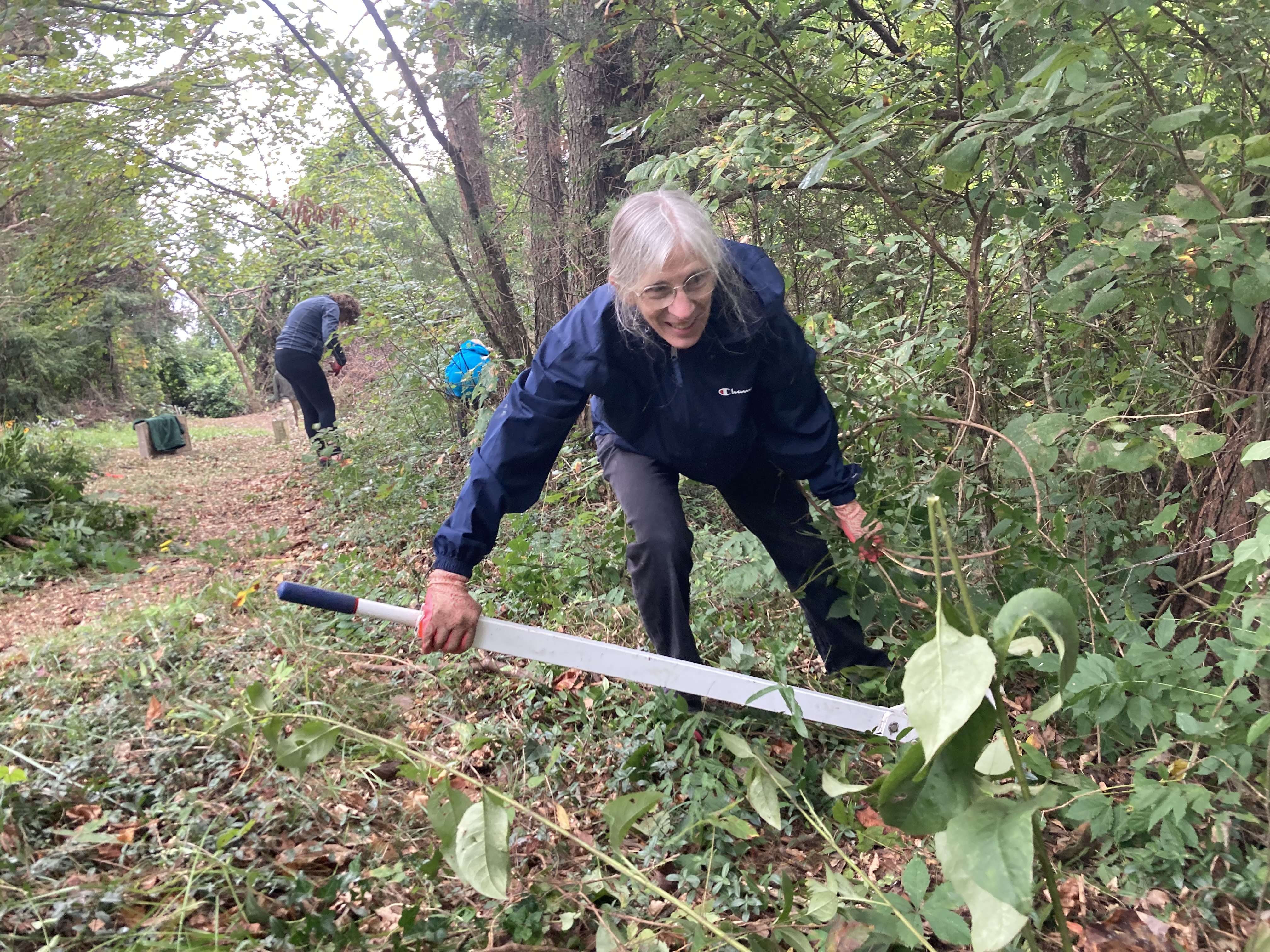 Anne Child removes invasive exotic plants during a recent Tennessee Citizens for Wilderness Planning event to mark National Public Lands Day at TVA’s Worthington Cemetery in Oak Ridge. Ben Pounds/Hellbender Press
Citizens pay it back on Public Lands Day in Oak Ridge, Smokies and beyond
OAK RIDGE — Rain drizzled as volunteers dug and clipped plants in woods around an old cemetery turned science lab.
It was a Public Lands Day event at Tennessee Valley Authority Worthington Cemetery Ecological Study area in Oak Ridge near Melton Hill Lake. Tennessee Citizens for Wilderness Planning, an environmental organization based in Oak Ridge, led the Sept. 24 work party in support of American public lands.
Other events were held throughout the country to mark the date (including Great Smoky Mountains National Park), which has proven itself to be the most productive day of the year for citizen sweat equity in public lands.
Celebrate the wild ties that bind Americans on Public Lands Day 2022 — Saturday, Sept. 24
Written by Thomas Fraser
GATLINBURG — The director of the National Park Service is expected in Great Smoky Mountains National Park on Saturday to celebrate National Public Lands Day.
Director Chuck Sams plans to make some remarks in appreciation for the volunteers who help backstop national park maintenance costs before citizens fan out for various tasks across the park. Sams is the first Native American to head the park service, and he will be joined by Eastern Band of Cherokee Indians Chief Richard G. Sneed.
Smokies researchers make a formal acquaintance with a familiar salamander
 Jonathan Cox
Great news from the Smokies via Instagram!
The “salamander capital of the world” just gained a new member! Meet our 31st species: the Cherokee black-bellied salamander, or Desmognathus gvnigeusgwotli. Its species name means “black belly” in the Cherokee language. Scientists used genetics to find out that it is different from the other black-bellied salamander in the park.
This salamander is common throughout the park and is known for its extremely dark belly and hunting along the banks of streams. If you see a large, dark-bodied salamander with a flattened tail resting on a river rock or poking its head out of a streamside hole, it’s likely the Cherokee black-bellied!
Remember to always appreciate salamanders and other wildlife from afar. Many of our salamanders breathe through their skin. The oils on our hands can stress them out, disrupt their breathing or even spread infections. Please help us keep our salamanders slimy and avoid picking them up!
— Great Smoky Mountains National Park
 You might have to pay to park at some of these trailheads in Great Smoky Mountains National Park starting next year. These old trail badges are displayed in Fontana Village on the south side of the Smokies. Thomas Fraser/Hellbender Press
Smokies parking fees will generate $7 million in revenue for park infrastructure
GATLINBURG — Getting outside just got more expensive.
Great Smoky Mountains National Park officials announced Monday the park would proceed with plans for a $5/per day parking pass required of all cars staying in one spot for more than 15 minutes.
Weekly passes will be $15, and annual passes will be available for $40, according to a release from the park service. Fees will also increase $3 for backcountry and campground permits, meaning campers and backpackers will have to fork over $8 a night.
Falling trees accountable for very few deaths in Smokies, but they do happen
CITIZEN TIMES: Child killed by falling tree was a very rare twist of horrible fate
Karen Chavez of the Asheville Citizen Times wrote a great article on tree-related deaths in Great Smoky Mountains National Park and beyond following the death last week of a Georgia child killed by a falling tree as she was occupying a tent in Elkmont Campground.
She reports the death of the child was only the 11th tree-linked death in the national park’s history.
The first such death was reported in 1934, when a Civil Conservation Corps worker was killed. Tree-related deaths since are normally associated with roadways and hiking trails.
“‘Deaths related to falling trees or limbs account for about 2 percent of total recorded deaths in the park. It’s an incredibly rare and tragic occurrence and accounts for the first-ever fatality caused by a tree falling on a tent in park history,’” according to an interview Chavez had with park spokeswoman Dana Soehn.
Falling tree kills child in Great Smokies
ELKMONT — A 9-year-old girl died early Wednesday after a tree fell on a tent she was occupying in Great Smoky Mountains National Park.
The unidentified child was among a group of people camping in Elkmont Campground when the red maple, 2 feet in diameter, fell shortly after midnight and crushed the girl in her tent, according to the National Park Service.
The girl and her family had traveled to the national park from Georgia. Her father and two siblings weren’t injured, according to the park service.
Elkmont Campground remains open, but the family’s campsite and an adjacent campsite were temporarily closed.
 A washout is seen along Porters Creek Road in Great Smoky Mountains National Park following torrential rain on July 12. National Park Service
Flooding causes Smokies damage, prompts water advisory for Sevierville
SEVIERVILLE — Extremely heavy rain on July 12 in the Smoky Mountains caused a cascade of problems now just coming to light.
Sevierville and Sevier County issued a boil-water advisory early Thursday after debris flushed by Tuesday’s floodwaters clogged the city water utility’s main intake on the French Broad River, leading to pressure decreases that opened up lines to possible outside contamination.
In Great Smoky Mountains National Park, Greenbrier campground was closed indefinitely after the swollen Middle Prong of the Little Pigeon River wiped out roads, trails and bridges in the area.
Smokies rangers kill bear after it hurts Elkmont campers while seeking food
Written by Thomas Fraser6-minute video about what to do if you see a black bear
Smokies officials say euthanized bear was overweight and seeking human food
GATLINBURG — Great Smoky Mountains National Park wildlife biologists and park rangers responded to Elkmont Campground on Sunday (June 12) after a peculiarly large black bear injured a toddler and her mother sleeping in a tent.
Wildlife biologists captured the responsible bear, and it was euthanized Monday, June 13, according to a news release from the park service.
“The bear weighed approximately 350 pounds, which is not standard for this time of year, suggesting the bear had previous and likely consistent access to non-natural food sources,” said Lisa McInnis, resource management chief.
 Parson Branch Road in Great Smoky Mountains National Park was reopened May 26 after a six-year closure. National Park Service
Parson Branch Road had been closed since 2016 because of washouts and danger from trees killed by the hemlock woolly adelgid
This article was provided by Great Smoky Mountains National Park Public Information Officer Dana Soehn.
CADES COVE — Great Smoky Mountains National Park officials celebrated on Thursday (May 26) the reopening of Parson Branch Road with a ribbon-cutting event honoring the crew who performed the needed work and the Friends of the Smokies who provided critical funding to support the efforts. The historic gravel road, originally constructed in 1838, is now reopened to the public after a six-year closure.
“We are pleased to reopen Parson Branch Road in time for the 2022 summer season,” said Deputy Superintendent Alan Sumeriski. “Not only does this restore access to one of the most special places in the Smokies, it also allows another opportunity for people of all abilities to spread out and explore less traveled areas of this very busy park.”
Smokies to reopen Parson Branch Road after massive clearance of trees killed by exotic insect
Written by Thomas FraserCADES COVE — Great Smoky Mountains National Park on Thursday plans to officially reopen Parson Branch Road, first cut through the ridges around Cades Cove 180 years ago.
The narrow, 8-mile one-way mountain road out of Cades Cove to U.S. 129 has been closed since 2016 following washouts that were compounded by a steady diet of collapsing diseased and dead hemlocks. A ceremony is set for Thursday morning at the beginning of the road in Caves Cove.
The road was closed because of the tree hazards and damage to the road surface. The hemlocks succumbed to the hemlock woolly adelgid, an exotic insect that has wreaked havoc on hemlock stands and their accompanying ecosystems.
More...
Blount County Commission committee rallies against Smokies parking fees ahead of superintendent Q&A
Written by Thomas FraserGATLINBURG — Great Smoky Mountains National Park Superintendent Cassius Cash hosted a dgital meeting April 14 urging the implementation of a $5 daily parking fee for Smokies visitors to raise money for park maintenance, law enforcement and visitor services.
The meeting included an overview presentation introducing the rate changes and a question and answer session.
Updated: Hatcher Mountain fire nearly extinguished; 300 structures affected
Written by Thomas Fraser Sevier County Emergency Management Agency
Forest fire above Wears Valley in Sevier County nears full containment; Seymour fire under control
UPDATE APRIL 4: The Sevier County Emergency Management Agency said the Hatcher Mountain/Indigo Lane fire is largely extinguished. Fire crews continue to further subdue the Millstone Gap fire near the Sevier/Blount county line.
The National Weather Service warns of continued high fire danger citing breezy winds and low humidity. Widespread rainfall is forecasted to fall beginning tomorrow.
Officials said the Hatcher Mountain fire ultimately burned 2,500 acres, and damaged or destroyed 300 structures.
UPDATE APRIL 1: Fire crews focusing on the stubborn Hatcher Mountain fire had to pivot in part early Friday to also fight a new wildfire in Seymour near the Blount and Sevier county lines.
Sevier County officials said the Wears Valley-area fire was 45-percent contained this afternoon following a significant brew-up late Thursday. At least 100 structures/dwellings had been “affected” by the fire, which has consumed at least 3,739 acres. Numerous rental cabins and homes have been lost.
Parson Branch Road improvements under way in Smokies
 Dead hemlocks are seen along Parson Branch Road near Cades Cove. National Park Service
CADES COVE — Great Smoky Mountains National Park contractors began removing at least 800 dead hemlock trees along Parson Branch Road, an eight-mile primitive backcountry road that connects Cades Cove with U.S. 129 on the western edge of the park.
The road has been closed since 2016 because of the tree hazards and damage to the road surface. The hemlocks succumbed to the hemlock woolly adelgid, an exotic insect that has wreaked havoc on hemlock stands and their accompanying ecosystems.
The road passes several trailheads, and is used by emergency vehicles as needed. The park initially identified some 1,700 trees that posed a hazard to the adjacent roadway, but that number has naturally declined by about half over the past six years.
Friends of Great Smoky Mountains National Park provided $100,000 for the hazard-mitigation project. That was matched with $50,000 from the federal government.
Once the dead trees are removed, work will begin to rehabilitate the roadway and ensure its safety.
The roadway could reopen this summer, according to a news release from the National Park Service.
A window on ursine motherhood in Cades Cove
As I was descending a wooded hillside in the heart of Cades Cove on a June afternoon, a motionless black bulk caught my eye off to my left.
I turned my attention there, regarded the scene for a few moments, and realized the sprawling blur was a large sleeping bear. A few moments more of inspection revealed three cubs snoozing in the branches overhead.