

15 Life on Land (18)
Protect, restore and promote sustainable use of terrestrial ecosystems, sustainably manage forests, combat desertification, and halt and reverse land degradation and halt biodiversity loss
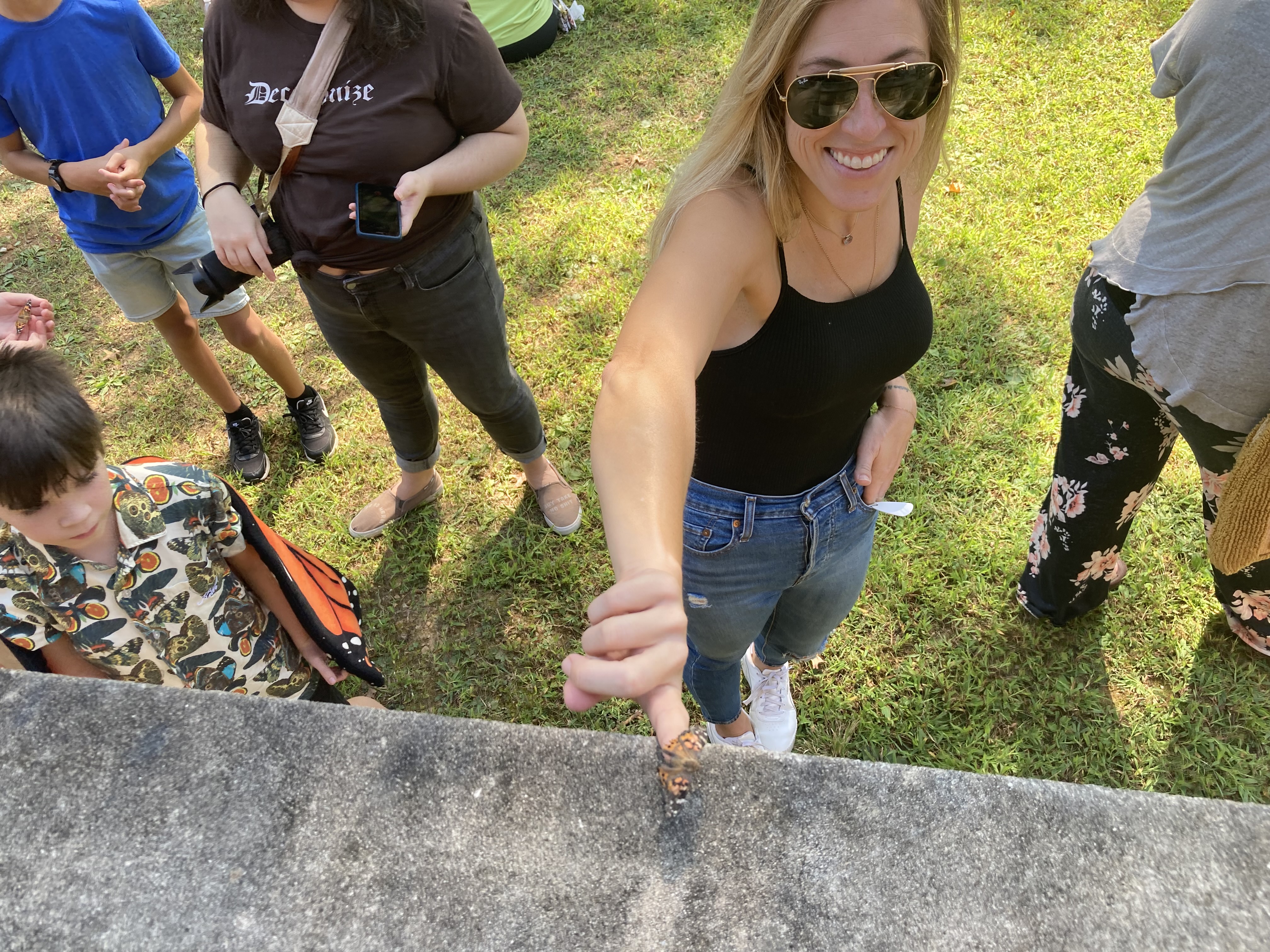 Kat Johnson meets a butterfly during a recent event at the University of Tennessee Arboretum in Oak Ridge. Ben Pounds/Hellbender Press
UT Arboretum event reminds us to love and care for the butterflies among us
OAK RIDGE — With an orange flutter, a cluster of painted lady butterflies took to the sky.
It was a timed release, coming toward the end of the seventh annual University of Tennessee Arboretum’s Butterfly Festival last month.
Earlier, other live painted lady butterflies were available to watch in mesh tents. Visitors got a chance to touch Madagascar hissing cockroaches and look at preserved insect collections with butterflies and other creatures from around the world. Children ran around the event with butterfly face paint, butterfly masks and butterfly wings. But the event was also a chance to buy butterfly-friendly plants and learn about butterflies and their relationships with other species.
- butterfly
- university of tennessee arboretum
- butterfly festival
- pollinator plant
- tennessee naturscapes
- michelle campanis
- stephen lynn bales
- georgeann eubanks
- family garden as butterfly habitat
- jerome grant
- migratory butterfly
- cosmopolitan butterfly
- butterfly garden
- painted lady butterfly
- zebra swallow butterfly
- tennessee state butterfly
- pawpaw
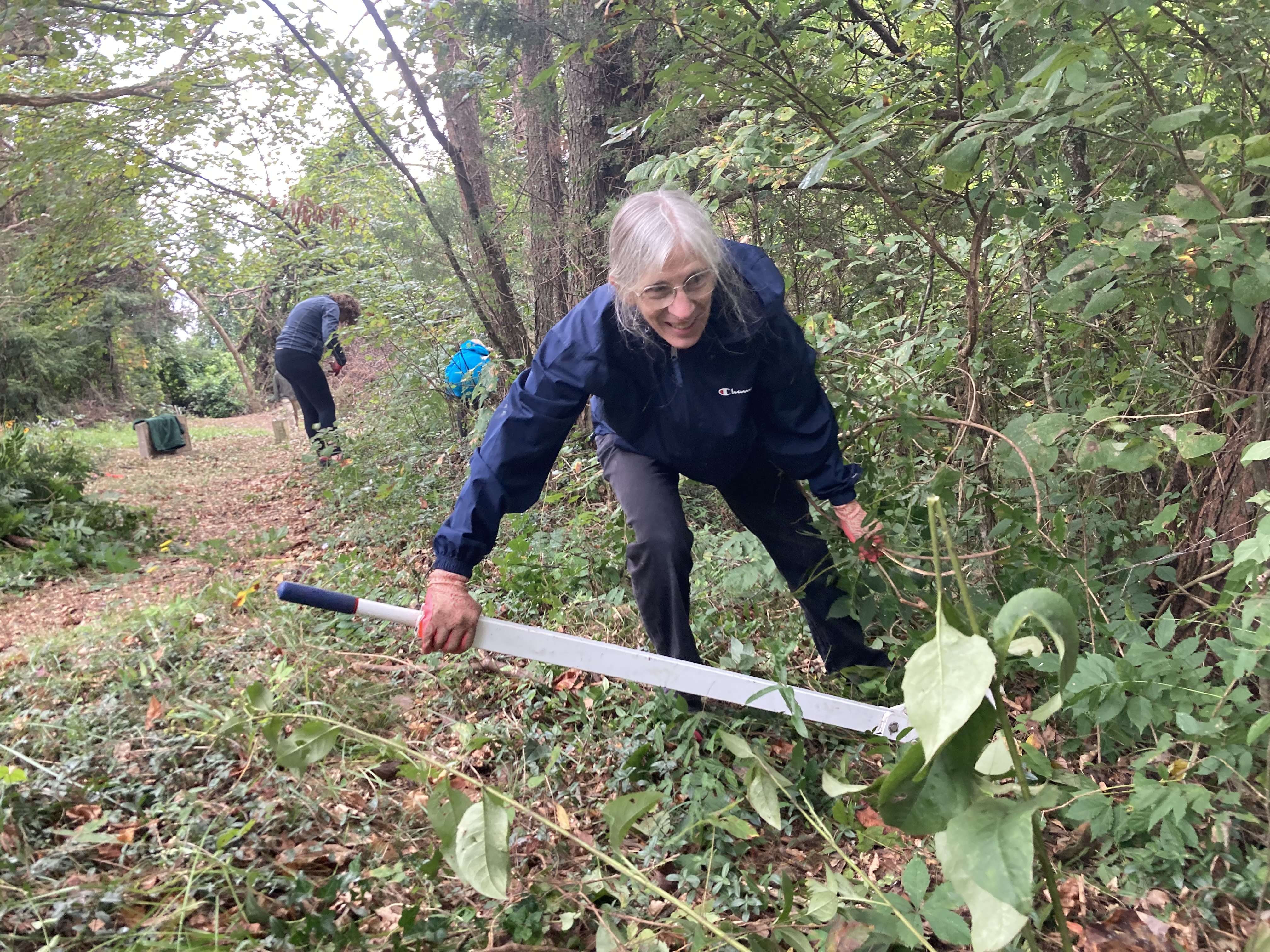 Anne Child removes invasive exotic plants during a recent Tennessee Citizens for Wilderness Planning event to mark National Public Lands Day at TVA’s Worthington Cemetery in Oak Ridge. Ben Pounds/Hellbender Press
Citizens pay it back on Public Lands Day in Oak Ridge, Smokies and beyond
OAK RIDGE — Rain drizzled as volunteers dug and clipped plants in woods around an old cemetery turned science lab.
It was a Public Lands Day event at Tennessee Valley Authority Worthington Cemetery Ecological Study area in Oak Ridge near Melton Hill Lake. Tennessee Citizens for Wilderness Planning, an environmental organization based in Oak Ridge, led the Sept. 24 work party in support of American public lands.
Other events were held throughout the country to mark the date (including Great Smoky Mountains National Park), which has proven itself to be the most productive day of the year for citizen sweat equity in public lands.
Celebrate the wild ties that bind Americans on Public Lands Day 2022 — Saturday, Sept. 24
Written by Thomas Fraser
GATLINBURG — The director of the National Park Service is expected in Great Smoky Mountains National Park on Saturday to celebrate National Public Lands Day.
Director Chuck Sams plans to make some remarks in appreciation for the volunteers who help backstop national park maintenance costs before citizens fan out for various tasks across the park. Sams is the first Native American to head the park service, and he will be joined by Eastern Band of Cherokee Indians Chief Richard G. Sneed.
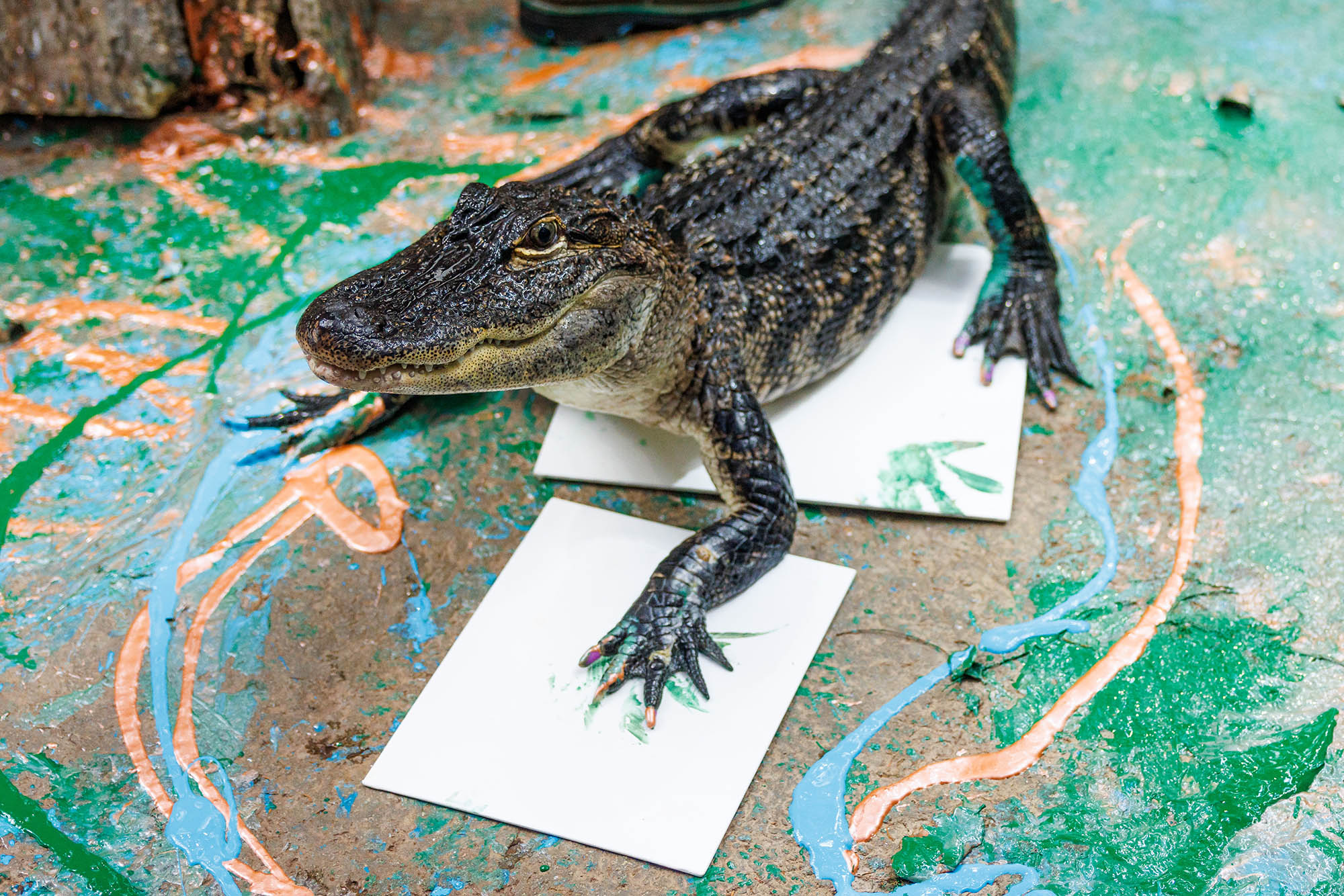 An American alligator (Alligator mississippiensis) paints art for the fall fundraising auction for the Tennessee Aquarium. The auction runs through Sept. 26. Tennessee Aquarium
Wildlife masterpieces mark an artistic autumnal fundraiser for the Tennessee Aquarium
CHATTANOOGA — While getting ready to tackle his next artistic masterpiece at the Tennessee Aquarium, Avior the red-ruffed lemur likes to take a few steps to center himself: languid naps in the sunshine, delicate nibbles of romaine lettuce, a resounding howl to focus his energy.
Only after these rituals are complete can this master of composition — a true “Lemur-nardo” da Vinci — begin putting paw and tail to canvas to create his next opus.
Avior’s latest triumph — made using non-toxic, animal-friendly tempura paint, naturally — is a 16-by-20-inch piece created in collaboration with his fellow lemurs and social media star Atlanta-based artist Andrea Nelson (TikTok video). Avior and Nelson’s masterwork is one of more than two dozen pieces of art made by aquarium animals now up for bid during the Tennessee Aquarium’s online fall fundraising auction. The auction will conclude at noon on Monday, Sept. 26.
Hunters are invited to go whole hog on the Tennessee side of Big South Fork
Written by Thomas Fraser Wild hogs are seen rooting in a sensitive area. Hog season opens later this month in Big South Fork. National Park Service
ONEIDA — Big South Fork National River and Recreation Area this week announced regulations for those wanting to kill invasive wild hogs during the 2022 fall and winter seasons.
Most hog populations within the protected areas of BSF are believed to be present on the Tennessee side of the park, which spans the Kentucky border. Feral hogs have been present in East Tennessee for generations. They destroy local flora and fauna mainly by rooting in low-lying mountain and valley areas. They are especially fond of salamanders, many species of which are in grave decline. In Great Smoky Mountains National Park, hunters are regularly deployed to cull hogs throughout the park.
“The wild hog is an invasive exotic species that has a significant negative impact to native species and do a great deal of damage to farmlands and residential areas. The damage they cause threatens park resources including federally listed plants,” according to a release from the park service.
Citizen scientists are taking stock in Smokies, and the inventory keeps increasing
Written by Thomas Fraser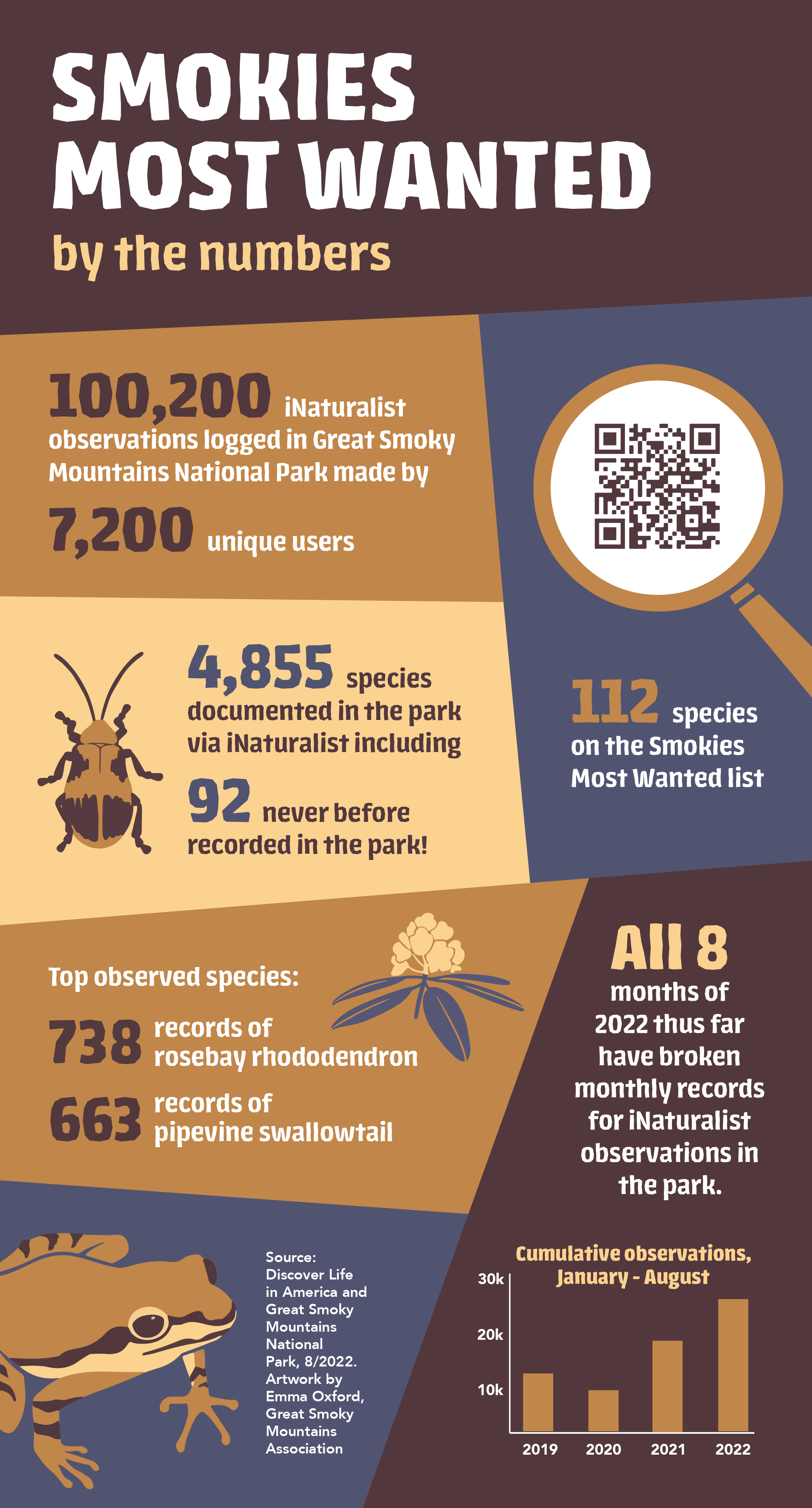
This story was provided by Great Smoky Mountains National Park.
Next demonstration on Thursday, Oct. 20
GATLINBURG — Great Smoky Mountains National Park is celebrating the success of a community science project led by nonprofit partner Discover Life in America (DLiA) called Smokies Most Wanted. The initiative encourages visitors to record life they find in the park through the iNaturalist nature app. DLiA and the park use these data points to map species range, track exotic species, and even discover new kinds of life in the park.
“iNaturalist usage in the Smokies has skyrocketed from just four users in 2011, to 3,800 in 2020, to now more than 7,100 users,” said Will Kuhn, DLIA’s director of science and research.
In August, the project reached a milestone, surpassing 100,000 records of insects, plants, fungi, and other Smokies life submitted through the app. Among them are 92 new species not previously seen in the park.
Last chance for comments in support of saving the country’s best remaining forests
 Old Growth U.S. National Park Service
On July 14, the U.S. Department of Agriculture and U.S. Department of the Interior opened a public comment period following President Biden’s Executive Order to conserve mature and old-growth forests.
The deadline for comments is Tuesday, Aug. 30. Now is the time to protect our federally managed forests to safeguard our communities from the future impacts of climate change. Make your voice heard and submit a comment to the U.S. Forest Service and the Bureau of Land Management.
The mature and old-growth trees in our federally managed forests are one of this country’s greatest resources. These forests provide critical habitats for wildlife, prevent erosion and flooding, protect our drinking water, and are an essential climate solution.
United States forests cover about 290 million hectares of land and make up the fourth largest forest area of any country in the world. In 2019, the carbon sequestered in these forests offset approximately 12 percent of United States greenhouse gas emissions.
— Sierra Club
 The Dust Bowl of the 1930s resulted in the displacement of tons of soil in the midst of a drought similar to the one that grips the Southwest today. Library of Congress
Dirt is far from just dirt. It’s a foundation for life.
This story was originally published by The Revelator.
Look down. You may not see the soil beneath your feet as teeming with life, but it is.
Better scientific tools are helping us understand that dirt isn’t just dirt. Life in the soil includes microbes like bacteria and fungi; invertebrates such as earthworms and nematodes; plant roots; and even mammals like gophers and badgers who spend part of their time below ground.
It’s commonly said that a quarter of all the planet’s biodiversity lives in the soil, but that’s likely a vast understatement. Many species that reside there, particularly microorganisms such as viruses, bacteria, fungi and protists, aren’t yet known to science.
- the revelator
- soil type
- soil moisture
- why is soil important
- drought
- soil microbe
- biodiversity
- soil microorganism
- nutrient cycling
- reading university
- climate change
- soil degradation
- plastic pollution
- genetically modified organism
- pesticide
- artificial fertilizer
- land use change
- compaction
- erosion
- convention on biodiversity
- soil biodiversity observation network
- global soil biodiversity initiative
- ecosystem research
- multidimensionality
- macroecology
- farm to fork strategy
- microbial transplants
- soil quality
- soil sealing
Monarch butterflies, an ephemeral but regular glimpse of beauty, are fluttering toward extinction
Written by Stephen Lyn Bales  A monarch butterfly, recently declared endangered despite decades of conservation, is seen atop a coneflower. Stephen Lyn Bales
Dramatic monarch declines mean the bell tolls for we
KNOXVILLE — Monarch butterflies are ephemeral by nature. The orange and black dalliances that flitter through our lives, our yards, and our countryside like motes of dust are here one minute and gone the next. We pause for a few seconds to watch the “flutter-bys” and then move on.
For about all of the Lepidopteran family, where they come from, where they go, their raison d'être, we don’t ask. They are winged wisps that pass through our busy lives. But that is not true with this orange and black butterfly, named to honor King William III of England, the Prince of Orange. But two people did ask.
Norah and Fred Urquhart lived in Southern Canada and in the late 1930s they noticed that the monarch butterflies seemed to all be fluttering south this time of the year. Could they possibly be migrating and if so, where did they go? The notion that a butterfly might migrate south for the winter seemed hard to fathom. Yes, broad-winged hawks migrate. But a flimsy butterfly?
- monarch butterfly
- monarch
- are monarchs endangered?
- stephen lyn bales
- stephen bales
- ijams nature center
- lepidoptera
- catalina aguado
- norah and fred urquhart
- flight of the butterflies
- xerces society
- great smoky mountains institute at tremont
- danaus plexippus ssp plexippus
- endangered species
- international union for conservation of nature
- pesticide
- pollinator
- habitat loss
- climate change
- herbicide
- mexico
Falcons in flight: Gatlinburg couple earns top conservation honors from Tennessee Wildlife Federation
Written by Deborah Sosower![Worsham Conservationist of the Year1]() Arrowmont supporters Margit and Earl Worsham named Conservationists of the Year by Tennessee Wildlife Federation
Arrowmont supporters Margit and Earl Worsham named Conservationists of the Year by Tennessee Wildlife Federation

This story was provided by Arrowmont School of Arts and Crafts.
GATLINBURG — Margit and Earl Worsham stood in front of family, friends, and fellow conservationists on stage in Nashville this spring and were presented with a unique award of mahogany shaped like a peregrine falcon in flight.
They were named the Tennessee Wildlife Federation’s 2022 Conservationists of the Year at the federation’s 57th Annual Conservation Awards in May.
It’s a prestigious honor presented to nominees considered to have the most significant contribution to the cause of natural resources conservation in Tennessee.
More...
HuffPost: More than 50 House Republicans want to repeal a century-old excise tax that bankrolls wildlife conservation
In the latest “gun rights” lash-out from the GOP, legislation has been filed to abolish firearms taxes levied on gunmakers that fund wildlife conservation.
The Republican legislation is framed as a way to defend gun purchasers from odious taxation under the 2nd Amendment umbrella, but leading hunting and fishing interests said the proposal is misguided and misses the target by a wide mark.
The levy as currently written applies to gunmakers, not individual firearms purchasers.
The GOP target is the Pittman-Robertson Act, which “helped confront decades of overhunting and habitat loss by creating a financial link between hunting and conservation,” according to HuffPost.
“This year, the Interior Department will distribute a record $1.5 billion to state wildlife agencies through the Pittman-Robertson Act and its fisheries equivalent, the Dingell-Johnson Sport Fish Restoration Act. To date, the programs have divvied up a combined $25.5 billion for conservation and outdoor recreation projects,” according to reporting from HuffPo reporter Chris D’Angelo.
Rare bipartisan legal effort under way for widespread wildlife protections
NYT: Recovering America’s Wildlife Act a big bipartisan push to preserve animal species
New York Times columnist Margaret Renkl noted recently that a precious opportunity has presented itself to strengthen wildlife-protection laws and add to environmental protections across the nation.
The Nashville-based journalist said the act, known as RAWA, “is poised to become the single most effective tool in combating biodiversity loss since the Endangered Species Act.” The resolution is carried in the House by Michigan Democrat Rep. Debbie Dingell.
“This bill provides funding for (1) the conservation or restoration of wildlife and plant species of greatest conservation need; (2) the wildlife conservation strategies of states, territories, or the District of Columbia; and (3) wildlife conservation education and recreation projects,” according to the U.S. Congress.
“The Department of the Interior must use a portion of the funding for a grant program. The grants must be used for innovative recovery efforts for species of greatest conservation need, species listed as endangered or threatened species, or the habitats of such species.
“In addition, the bill requires certain revenues generated from fees and penalties for violations of environmental requirements to be used as a source for the funding.”
The legislation, which has already passed the House of Representatives, would allocate $1.4 billion each year across the country to protect and restore endangered plant and animal populations, and protect species already tipping toward endangered status. It is up for consideration in the Senate, where it has already garnered the support of at least a dozen Republicans and a majority of Democrats, virtually ensuring its passage, according to Renkl.
“You don’t have to nurse a fondness for spotted owls or snail darters — creatures at the heart of two of the most contentious environmental debates in recent history — to understand that what is best for the ecosystems we share with nonhuman animals is what’s best for us, too,” Renkl wrote.
Smokies rangers kill bear after it hurts Elkmont campers while seeking food
Written by Thomas Fraser6-minute video about what to do if you see a black bear
Smokies officials say euthanized bear was overweight and seeking human food
GATLINBURG — Great Smoky Mountains National Park wildlife biologists and park rangers responded to Elkmont Campground on Sunday (June 12) after a peculiarly large black bear injured a toddler and her mother sleeping in a tent.
Wildlife biologists captured the responsible bear, and it was euthanized Monday, June 13, according to a news release from the park service.
“The bear weighed approximately 350 pounds, which is not standard for this time of year, suggesting the bear had previous and likely consistent access to non-natural food sources,” said Lisa McInnis, resource management chief.
Sam Adams raises trees like healthy children at the University of Tennessee
Written by Keenan Thomas University of Tennessee arborist Sam Adams stands in front of a blooming dogwood on the campus of UTK. Keenan Thomas/Hellbender Press
First campus arborist continues climb up Utree Knoxville
KNOXVILLE — Students at the University of Tennessee walk by hundreds of trees every day without thinking about them.
Sam Adams was thinking about them even before he became UT’s first arborist.
Adams, 58, has cared for trees in the field of arboriculture for decades. He’s worked privately and publicly, including as arborist supervisor for Sarasota County, Florida. He graduated with a degree in environmental studies at Warren Wilson College in North Carolina, where he initially pursued a degree in English.
- ut arborist
- ut tree
- sam adams utk
- jim cortese
- trees knoxville
- University of Tennessee
- university of tennessee knoxville
- sam adams
- jack neely
- knoxville history project
- knoxville history
- cortese tree
- keenan thomas
- ut journalism school
- hellbender press ut
- knoxville persimmon
- trees in knoxville
- utk history
- civil war knoxville
- the hill ut
- tree care
- what does an arborist do?
- clearing trees at utk